
Home/Wellness Zone/Sakra Blogs

6th Mar, 2017

Women have been breastfeeding since the beginning of time, but it cannot be stated that every woman is always prepared to breastfeed. Every woman who experiences childbirth for the first time is completely new to breastfeeding as well. Nursing can be a little tough in the beginning, but with patience, effort, guidance and lots of support, both the mother and the baby can get a hold of it.
It is always good to try and learn breastfeeding in the hospital as soon as possible and be get guidance from a nurse or a lactation consultant. Though a newborn knows instinctively how to suck, getting his lips and your nipple in the right position (called "the latch") may take some time to settle. Minor adjustments might be required as the nipple may slip out of baby's mouth, or the baby may not know, or may cry, or may just be too sleepy from the birth process.
The mother should not get discouraged due to the small challenges that might come in the beginning. These can be dealt with the help of nurses and lactation consultants or an older women in the family and can develop an understanding and get comfortable with the whole process. Also even if does not get right for several hours (or a whole day), the baby will not starve.
Since feeds can take anything from five to 40 minutes, the mother should always be seated in a comfortable position for breastfeeding. It is important to have calm and comfortable surroundings especially in the early days of breastfeeding until one gets accustomed to it.
The baby should be held in a position that is comfortable for the baby as well as the mother to avoid any pain in the arm or the back. Cushions and pillows can be used to give support to the baby or the mother's hand and back. Every mother and baby is unique and will have their own breastfeeding style.
It the latching or the sucking hurts, the suction can be interrupted by inserting the little finger in the corner of the baby's mouth between the baby's gums and the nipple. Once the baby latches on properly, the feeding can resume.
Always let the baby feed fully from just one breast rather than alternating between both breasts, which can lead to the baby getting more of watery foremilk, but not enough of the fat-enriched hindmilk. This can lead to a fussy baby who wants to breastfeed often.
If the baby still feels hungry after feeding on the first breast, the second can be offered. But always remember to burp before restarting the feed. And after every complete feed.
Some Breastfeeding positions
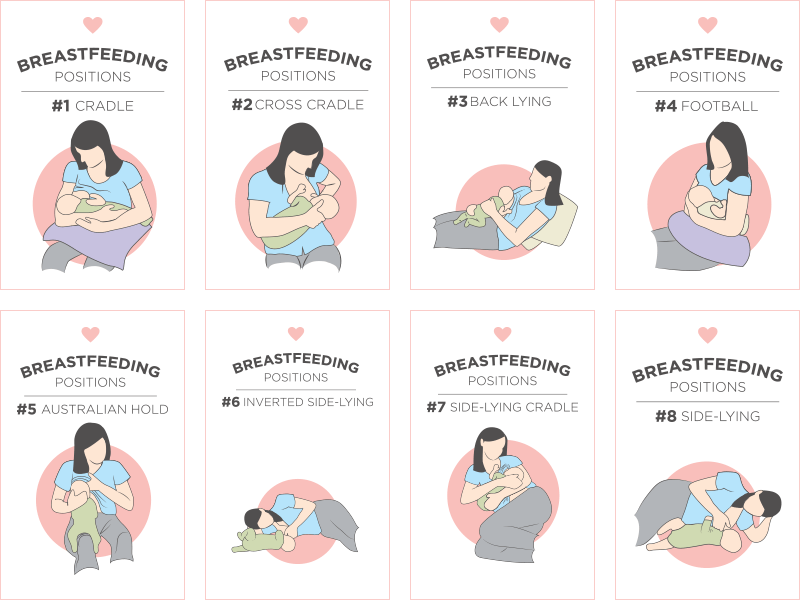
What are the common problems that one can face in breastfeeding?
Some women adjust to breastfeeding easily while many new mothers find it hard to get used to it. A new mother’s breasts have never been subjected to the jaws of a hungry newborn before, so for most moms, it hurts in the beginning. In the first six weeks, as mother’s milk supply adjusts and the baby learns how to breastfeed, and the mother may suffer from some of the following problems:
Engorgement - overfull breasts
Mastitis – an infection in the breasts due to bacteria that enter the breast and multiply in the milk duct causing pain and inflammation.
Cracked, bleeding or sore nipples
Breastfeeding takes patience and practice. The mother should never lose hope and whenever faced with a problem should always seek help or advice.
What is the right time and the right process to stop breastfeeding?
According to World Health Organization it is recommend that babies are given only breast milk for their first six months. This is called exclusive breastfeeding. It is also said that women should carry on breastfeeding even after their babies have started on solid food, until the end of the first year and beyond if they wish.
Doctors advise breastfeeding exclusively for about six months. After which the baby can be supplemented with semi-solid diet while continuing to breastfeed, until the baby stops taking breast milk completely. Some mothers choose to stop breastfeeding (this is known as weaning) when the baby starts eating a wide variety of food.
Vaginal discharge can change
22 Sep 2026

Menstrual periods stop permanently
22 Sep 2026

Ovarian cysts are fluid-filled
22 Sep 2026

Egg freezing, medically known
22 Sep 2026

Ovulation is the process
22 Sep 2026

Pregnancy increases the body’s
22 Sep 2026

If you think PCOS means
16 Sep 2026

Irregular periods refer to
31 Jul 2026

Vaginal bleeding refers to
31 Jul 2026

Staying active during pregnancy
5 Jun 2026

Breastfeeding is one of
5 Jun 2026

Preterm labor is a
5 Jun 2026
Ovarian cysts are fluid-filled sacs
4 Jun 2025
Vaginal yeast infections are a
4 Jun 2025

Women’s health is a vast
4 Jun 2025

Thyroid disorders in pregnancy can
13 Mar 2025
Abnormal Uterine Bleeding (AUB) is
17 Nov 2023

Pregnancy is a miraculous and
17 Nov 2023

Pregnancy is a beautiful and
17 Oct 2023

Polycystic Ovary Syndrome (PCOD) is
13 Oct 2023

Hearing aids and cochlear implants
13 Jul 2023

Pregnancy is probably one of
28 May 2020

Can Oral Health Have an
29 Jan 2018

How can high-risk pregnancies be
6 Mar 2017

What is a High Risk
6 Mar 2017

Fetal medicine and its role
6 Mar 2017

Women have been breastfeeding since
6 Mar 2017

It is an act that
6 Mar 2017

0n 14th Feb 2017, while
3 Mar 2017

Osteoporosis
2 Sep 2014
Enquire Now