
Home/Wellness Zone/Sakra Blogs

3rd Feb, 2026
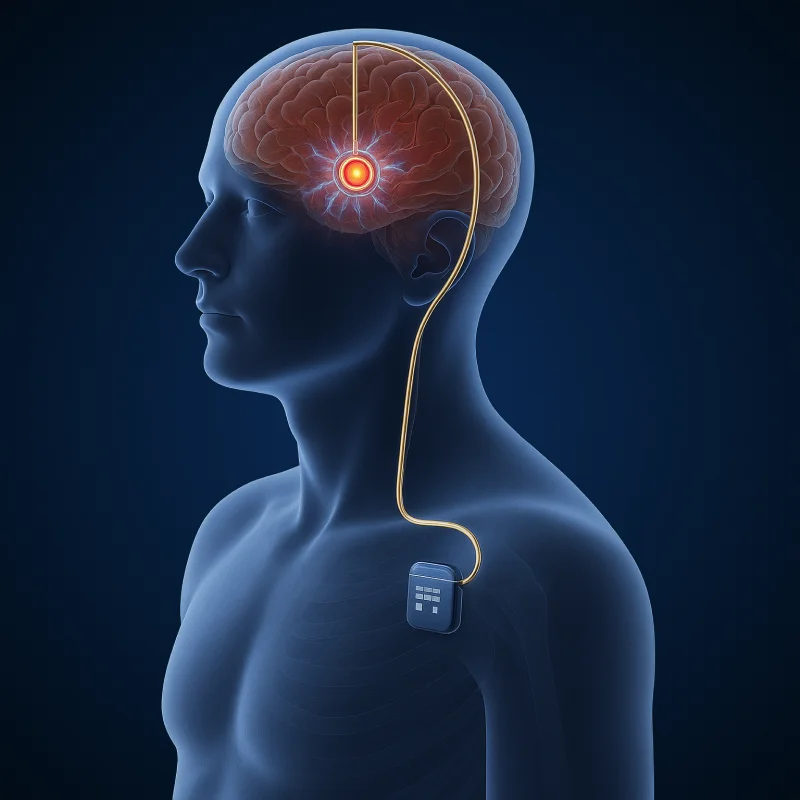
Deep brain stimulation (DBS) has long served as a transformative surgical intervention for patients with advanced Parkinson’s disease whose motor symptoms, such as tremors and rigidity, are no longer well-managed by medication alone. Often compared to a "pacemaker for the brain," the procedure involves the minimally invasive implantation of thin electrodes into specific targets, such as the subthalamic nucleus or the globus pallidus. These electrodes deliver controlled electrical pulses that disrupt the pathological neural firing patterns responsible for movement disorders, frequently allowing patients to significantly reduce their dependency on oral medications and alleviating drug-related side effects.
The most significant advance in 2026 is the widespread clinical adoption of Adaptive Deep Brain Stimulation (aDBS), a "closed-loop" system that personalizes therapy in real-time. Unlike traditional "open-loop" systems that provide constant, fixed levels of electricity, aDBS uses sensing technology to detect a patient's unique brain signals, known as local field potentials (LFPs). By monitoring these biomarkers—specifically those in the beta frequency range—the device automatically adjusts the stimulation intensity to match the patient’s immediate needs, such as increasing output during periods of severe stiffness or decreasing it when symptoms are stable.
Parallel breakthroughs in directional lead technology and Multiple Independent Current Control (MICC) have further refined the precision of this surgery. While older leads produced a simple spherical field that often spilled into adjacent brain regions, new directional leads are segmented, allowing neurosurgeons to "steer" the current precisely toward therapeutic targets while avoiding areas that trigger side effects like speech difficulties or muscle contractions. MICC technology enhances this by giving clinicians independent control over the current for each individual contact on the lead, providing a three-dimensional level of customization that can even compensate for slight surgical misplacements.
Beyond the hardware itself, 2026 has seen the integration of artificial intelligence (AI) and remote programming to streamline postoperative care. Modern systems now use AI algorithms to analyze wearable sensor data—such as a patient's gait or tremors—to recommend optimized stimulation settings. Furthermore, remote programming platforms now allow neurologists to adjust a patient's device settings via secure Bluetooth and internet connections, eliminating the need for frequent in-person hospital visits. These innovations, combined with the development of smaller, MRI-compatible, and long-lasting rechargeable batteries, have firmly established DBS as a highly effective and increasingly accessible frontline therapy for Parkinson's disease.
Sakra hospital bangalore had a dedicated parkinsons clinic with neurologist and neurosurgeon specially trained in dbs surgery. Already succesfully completed 5 cases in the last 2 months . Patients are doing exceddingly well gollowing surgery.
Deep brain stimulation (DBS)
3 Feb 2026

Sciatica is a common
10 Nov 2025

Almost everyone experiences neck
10 Nov 2025
Hydrocephalus is a neurological condition
12 Jun 2025
A blood clot in the
12 Jun 2025
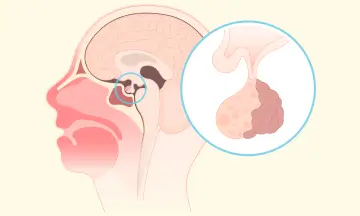
What are pituitary tumors, and
16 Sep 2024
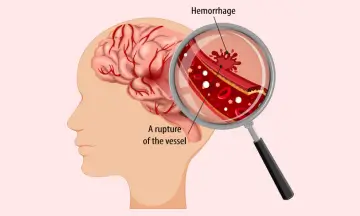
What is brain hemorrhage and
16 Sep 2024
Brain tumors can be a
16 Jul 2024
Functional neurosurgery is a specialized
16 Jul 2024
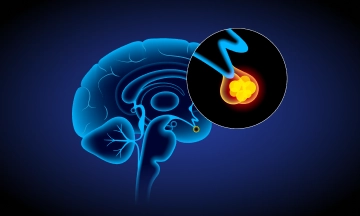
What are pituitary tumors, and
10 Apr 2024
Brain tumours are the most
1 Apr 2024
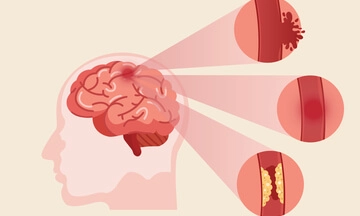
Stroke is the leading cause
25 Jan 2021
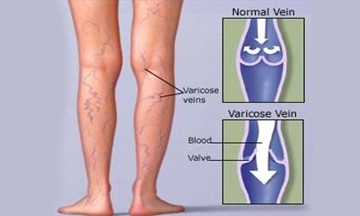
What is a varicose vein Varicose
13 Nov 2019
What if you had a
16 Oct 2018
What is a Stroke? Stroke is
9 Nov 2017
Bengaluru doctors claim it to
21 Jul 2017
A pituitary adenoma
12 Jan 2015
Craniosynostosis is derived
28 Nov 2014

For a vast
24 Sep 2014

Can we imagine
18 Jul 2014
Enquire Now