Home/Centres & Specialities/Robotic Assisted Rehabilitation
At Sakra World Hospital, we are committed to providing cutting-edge medical care to our patients, particularly in the field of rehabilitation. One of the most innovative and effective advancements in rehabilitation therapy is robotic-assisted rehabilitation, which has revolutionized the way we treat patients with neurological, musculoskeletal, and orthopedic conditions. By incorporating state-of-the-art robotic technology, we offer patients a more precise, efficient, and effective recovery journey.
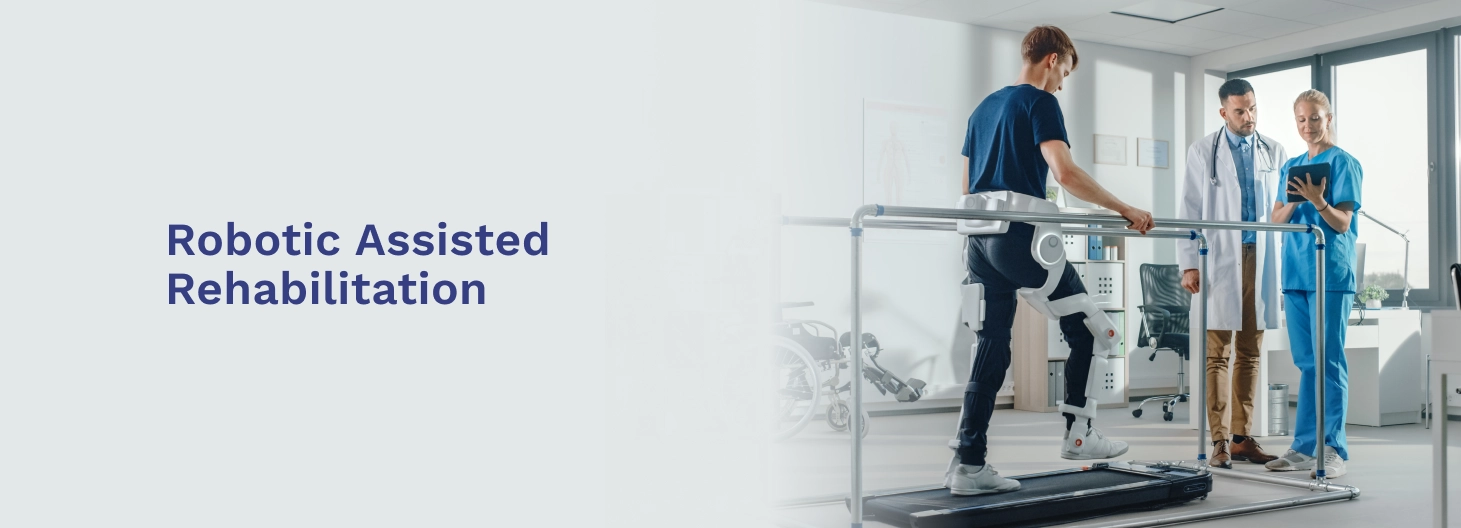
Robotic-assisted rehabilitation refers to the use of robotic technology with traditional therapeutic practices to help patients recover from injuries, surgeries, or neurological conditions. The robotic systems are used to support, guide, or augment the movements of patients during therapy. This advanced technology offers a high level of precision, consistency, and personalized treatment, allowing improvements in less time.
Robotic-assisted rehabilitation at Sakra World Hospital begins with a comprehensive evaluation by our multidisciplinary team, which includes neurologists, physiatrists, and rehabilitation therapists. Based on the patient’s medical condition, recovery goals, and functional abilities, we design a personalized rehabilitation program.
Our expert therapists closely monitor the patient’s performance, adjusting parameters such as speed, difficulty, and intensity to ensure that the therapy remains challenging and effective. This dynamic, adaptive approach helps to maximize the benefits of robotic-assisted rehabilitation, ensuring faster and more comprehensive recovery.
Robotic-assisted rehabilitation uses robotic devices to support and guide repetitive movements during therapy. It can help improve mobility, strength, coordination and functional independence under the supervision of rehabilitation professionals.
It may benefit people with movement difficulties following stroke, spinal cord injury, traumatic brain injury, neurological disorders or certain orthopaedic conditions. A rehabilitation specialist can determine whether robotic therapy is appropriate based on the individual's condition and rehabilitation goals.
Robotic-assisted rehabilitation may be used for stroke, spinal cord injury, traumatic brain injury, cerebral palsy, Parkinson's disease, multiple sclerosis and other conditions affecting movement. It can also support recovery after certain surgeries or injuries when recommended by a rehabilitation team.
Robotic systems allow patients to practise controlled, repetitive and task-specific movements while the level of assistance can be adjusted to their abilities. This may help improve gait, balance, coordination, muscle activation and overall functional mobility.
The robotic device supports or guides the affected limb while the patient performs repeated movements under therapist supervision. The level of assistance can be gradually adjusted as the patient's strength and movement improve.
Yes, robotic-assisted therapy can be incorporated into stroke rehabilitation to support walking, balance and upper-limb movement. It works best as part of a personalised rehabilitation programme rather than as a replacement for conventional therapy.
The duration varies depending on the condition, severity of movement impairment, treatment goals and response to therapy. Some patients may require several weeks or months of rehabilitation, with the programme adjusted according to their progress.

SY NO 52/2 & 52/3,
Devarabeesanahalli, Varthur
Hobli, Bangalore- 560 103

Health Tips, News & Updates

Enquire Now