

Home/Wellness Zone/Sakra Blogs

26th Oct, 2026
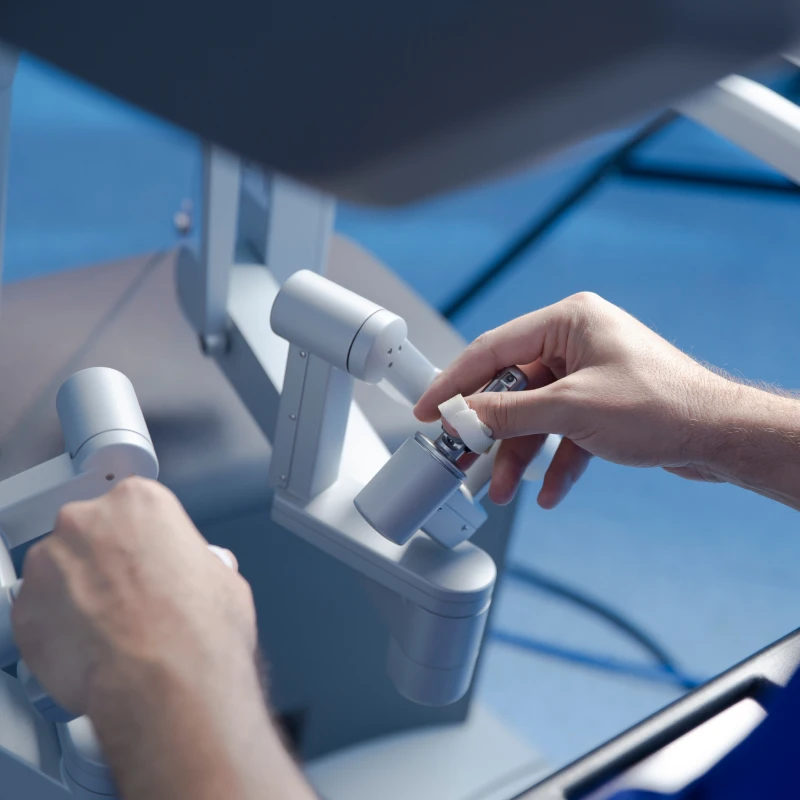
A bulge in an old operation scar. A swelling at the navel that grows slowly over the years. A ridge down the middle of the abdomen that appears whenever you sit up. These are the ordinary ways an abdominal wall hernia announces itself — and the way we repair them has changed a great deal.
Patients who come with an abdominal wall bulge almost always ask the same first question: "Will this be done by robot?"
It is a fair question, but it is the second one. The first is what sort of hernia you actually have — because a one-centimetre defect at the navel and a hand-sized hernia through an old midline scar are not the same problem, and they should not receive the same operation. Once that is settled, the robotic platform becomes relevant for a specific reason: it lets us perform each of these operations more precisely, and perform the harder ones through small incisions rather than a long cut down the abdomen.
Let me take you through how that choice is made.
"Ventral" simply means the front of the abdomen. A ventral hernia is a gap in the muscular wall there, through which fat or a loop of bowel can push outward. It may appear at a naturally weak spot such as the navel, or through the scar of a previous operation, where the healed muscle layer has quietly given way. The latter is called an incisional hernia, and it is among the most common problems we treat.
Alongside this, many patients have divarication of the recti — the two vertical "six-pack" muscles drifting apart, with the tissue between them stretched thin and wide. It is common after pregnancy and with weight gain, and it worries people a great deal, usually more than it should.
Divarication is a stretched midline, not a hole — so it cannot trap bowel. A true hernia is a genuine defect. The two often occur together, which is why we assess both before planning any repair.
Because divarication is not a true hernia, it carries no real risk of anything becoming trapped, and on its own it does not need an operation for safety. We address it when it causes genuine problems — core weakness, backache, significant distress about the shape of the abdomen — and most often when a true hernia nearby needs repairing in any case. It does, however, change the plan: a wide divarication alongside a hernia calls for a different operation from the same hernia in an otherwise firm abdominal wall.
Almost every repair uses a mesh, because closing a gap in the abdominal wall with stitches alone fails too often. The abdominal wall is built in layers, and the mesh can be placed in different ones. Both of the main positions are sound operations. The art is in choosing between them.
Two sound positions for the mesh. Which one suits you depends mainly on the size of the hernia, on whether the midline is also stretched, and on what previous surgery you have had.
Smaller Hernias: The Mesh Inside the Abdomen
For a small defect — a modest umbilical hernia, a small hernia in a scar — the sensible operation is often the simplest one. The surgeon works inside the abdominal cavity and places a specially coated mesh against the inner surface of the wall, after first stitching the gap itself closed. It is quick, it is well established, and for the right hernia it gives an excellent result. There is no benefit in subjecting a small hernia to a bigger reconstruction than it needs.
The traditional criticism of this repair concerns how the mesh is held in place. Conventionally it is anchored with tacks, or with stitches driven through the entire thickness of the abdominal wall — and those deep anchors are a recognised cause of discomfort in the early weeks after surgery.
This is one of the places where the robotic platform quietly changes the operation. Because fine suturing is straightforward at the console, the mesh can instead be secured with a series of individual stitches placed around its edge, each taking only a superficial bite of the wall. It holds the mesh every bit as securely, but nothing is driven through the full thickness, and the tacks can be dispensed with altogether. The repair is the same. The anchors that cause the early pain are not there.
Whichever plane the mesh goes into, avoiding anchors driven deep through the abdominal wall is where much of the early comfort comes from.
Larger Hernias and Divarication: The Mesh Within the Wall
When the defect is bigger, when there are several defects along the midline, or when the midline itself is stretched wide by divarication, covering the gap from inside is no longer the right answer. These abdomens need to be rebuilt rather than patched.
Here the mesh is placed within the wall itself — in the space behind the muscle but in front of the lining of the abdomen. In the approach known as eTEP, the whole operation is carried out within the layers of the abdominal wall, without entering the abdominal cavity at all. The stretched midline is folded and stitched so that the separated muscles come back towards each other, the defect is closed properly, and a large mesh is laid in the pocket behind.
In that position the mesh sits where the body's own internal pressure presses it flat against the wall and holds it there, so it needs little or no fixation. It never touches the bowel. And because the abdominal cavity is never entered, patients who have had previous surgery are spared a long and tedious separation of adhesions.
Complex Hernias: Adding a Muscle Release
In the largest and most difficult hernias, the muscles have retracted so far sideways that the midline simply cannot be brought together without excessive tension. For these — and only for these — the same approach is extended to release a deeper muscle layer on each side, which allows the wall to be advanced to the midline and closed properly, and creates a very wide space for a large mesh.
This is genuine abdominal wall reconstruction, and it is reserved for complex cases. Until recently it was an open operation requiring a long incision and several days in hospital. Being able to offer the same reconstruction through a handful of small incisions is the most significant change this technology has brought to our field.
The advantage is specific rather than general, and it differs a little depending on which of the above operations you are having.
Accurate Closure of the Defect
Across all of these repairs, the gap in the abdominal wall should be properly closed before the mesh is placed — not merely bridged over. A hernia whose defect has been closed behaves better, functions better and is less likely to trouble you later than one that has only been covered.
Closing a defect neatly through conventional keyhole instruments is awkward work. The instruments are rigid, the angles are unhelpful, and the surgeon is standing with arms raised. At the console, the instruments bend near the tip much as a human wrist does, the image sits directly in front of the surgeon, and the hands work in a natural, supported position. Stitching that is difficult and slow by conventional means becomes controlled and unhurried — and a midline closed accurately, without tension, is a midline more likely to stay closed.
Suturing Instead of Deep Anchors
The same facility with suturing is what allows the mesh to be stitched in place rather than tacked, whichever plane it sits in. In a small repair, that means superficial bites instead of anchors through the full thickness. In a larger repair, it means the mesh can often simply rest in its pocket with minimal fixation. Either way, the patient is spared the deep fixation that causes much of the early discomfort.
Seeing and Preserving the Nerves
In the larger repairs, where we work within the layers of the abdominal wall, this matters more than anything else I could tell you about the technology.
The muscles of your abdominal wall are supplied by a set of fine nerves that run in the very layer being opened, entering the muscle from the side. Injure them and the muscle they supply becomes weak — meaning you have weakened the wall you set out to rebuild. The consequence may be a bulge appearing months later, or an abdomen that never regains its former firmness.
Under high magnification and in three dimensions, these fine nerves stand out clearly as the pocket is developed — which means they can be identified and deliberately preserved.
With the naked eye, or on a flat two-dimensional screen, these nerves are easy to miss. Under magnified three-dimensional vision they are clearly visible, and can be worked around with intent rather than avoided by luck. This is an argument about the long-term quality of your result, not about the first few days — and in my view it is the strongest single reason to use the platform for the larger repairs.
Gentler on the Ports, and Often Fewer of Them
In conventional keyhole surgery the instruments are rigid rods that must pivot at the point where they enter the body. Every movement inside is paid for by a lever movement at the port, and the abdominal wall absorbs that repeated torque. Because robotic instruments articulate internally, far more of the work happens at the tip and far less is transmitted to the port sites. Patients are generally more comfortable at those small wounds in the early days, and in my experience need less in the way of strong painkillers.
The reach and flexibility of the instruments also mean that even complex repairs can frequently be completed through fewer ports than the conventional equivalent would need. Fewer wounds in the abdominal wall is a modest benefit, but a real one.
These things tend to compound. The right operation is chosen for the size of the hernia. The defect is closed accurately. The mesh is stitched rather than anchored deep. The nerves are preserved. The ports are handled more gently. Each contributes something, and the sum of them is what patients experience as a smoother recovery.
Five Things to Be Clear About
The robot does not make decisions. Which operation, which plane, which mesh, how much to release — every judgement is the surgeon's.
The robot does not operate by itself. It has no independence whatsoever. It moves only while the surgeon moves the controls, and stops the moment he stops.
It does not abolish complications. Fluid collections, infection, injury to nearby structures and recurrence all remain possible, and a large reconstruction is major surgery whichever way it is performed.
It does not give you a flat abdomen. A hernia repair is not a cosmetic tummy tuck, and loose skin is not removed.
It does not mean every hernia needs a big operation. Matching the repair to the hernia is the whole point. Recommending more than a patient needs is not good surgery.
Who Stands to Benefit Most?
Incisional hernias — hernias through the scar of a previous operation, where the wall can now be rebuilt without reopening the whole abdomen.
Larger hernias, where the muscles have drawn apart and the midline must be properly restored rather than simply covered.
A hernia with significant divarication, where bringing the muscles back together and reinforcing the midline are planned as a single operation.
Several defects along the midline, which can be addressed together in one continuous pocket.
Complex hernias needing a muscle release, where the alternative has traditionally been a major open reconstruction.
Patients with extensive previous surgery, where staying outside the abdominal cavity avoids a difficult separation of adhesions.
Smaller hernias too, where the benefit is narrower but genuine: an accurately closed defect and a mesh stitched to the superficial layers rather than anchored deep.
Equally, there are situations where I would advise against it: a patient not fit for a longer anaesthetic, since these are longer operations; active infection; and — importantly — anywhere the operating team does not have real experience of the specific technique. If you smoke, or your diabetes or weight are poorly controlled, time spent improving those before surgery will do more for your result than any choice of platform. That delay is worth it.
Recovery varies widely, because "ventral hernia" covers everything from a small umbilical defect to a full reconstruction of the abdominal wall. Broadly:
Small and moderate repairs are frequently day-care or a single night in hospital.
Large reconstructions usually mean a few days, sometimes with drains, and a more gradual recovery at home.
Walking begins the same day in nearly every case. Early movement is part of the treatment, not a test of endurance.
Eating is usually possible the same evening after a smaller repair. After a major reconstruction the bowel may take a day or two to settle.
An abdominal binder is often advised for the first few weeks, for comfort and to reduce fluid collection.
A seroma — a collection of fluid at the repair site — is common, feels alarmingly like the hernia coming back, and usually settles over several weeks. Please have it looked at rather than assuming the worst.
Returning to work is commonly possible within one to two weeks after a smaller repair, and takes longer after a reconstruction. Heavy lifting is built up gradually over about six to eight weeks. These are larger repairs than groin hernias, and the advice is deliberately more cautious.
I will be straightforward with you: hernias of the abdominal wall come back more often than groin hernias do. How likely that is depends on the size of the original defect, on whether the midline was genuinely closed rather than simply bridged, on the position and size of the mesh — and on things within your own control, particularly smoking, weight and diabetic control.
What I can say with confidence is that patients who have a well-planned, well-matched repair generally feel substantially better, and stay better. The dragging discomfort goes. Core strength returns. People stop arranging their day around a bulge, stop worrying about what it might be doing, and go back to lifting their grandchildren and going to the gym. That improvement in ordinary life is the point of the operation, and it is what I would want you to weigh.
If you are considering surgery for an abdominal wall hernia, these are the questions worth asking your surgeon: Which operation suits the size of my hernia, and why that one? Where will the mesh be placed? Will the gap actually be closed, or only covered over? Is my divarication being addressed as well?
A surgeon who answers those questions clearly is telling you more than any brochure about technology can.
The goal is not to choose the most sophisticated technology. The goal is to choose the right operation for the right patient — and then to perform it well.
1. What Is a Ventral Hernia, and How Is It Different From an Incisional Hernia?
A ventral hernia is a gap in the muscular wall at the front of the abdomen, through which fat or a loop of bowel can push outward and form a bulge. An incisional hernia is one particular type of ventral hernia — one that appears through the scar of a previous abdominal operation, where the healed muscle layer has quietly given way.
2. Is Divarication of the Recti the Same as a Hernia?
No. Divarication is a widening of the gap between the two vertical abdominal muscles, with the tissue between them stretched thin but still continuous. Because there is no actual hole, nothing can become trapped, and it carries no emergency risk. It often occurs alongside a true hernia, and the two can be corrected together.
3. Does a Small Hernia Need the Same Operation as a Large One?
No — and it should not have one. A small defect is usually best treated by closing the gap and placing the mesh inside the abdomen, which is a quick and reliable repair. Larger hernias, or those with a stretched midline, need the mesh placed within the wall itself so that the abdominal wall can be properly rebuilt rather than simply patched.
4. Where Is the Mesh Placed in Robotic Ventral Hernia Repair?
In one of two positions, chosen according to the hernia. For smaller defects the mesh sits inside the abdomen, against the inner surface of the wall. For larger hernias it is placed within the wall itself — behind the muscle and away from the bowel — where the body's own internal pressure holds it flat with little or no fixation needed.
5. Is Robotic Hernia Repair Less Painful?
Much of the early discomfort after hernia surgery comes from tacks or stitches driven through the full thickness of the abdominal wall to hold the mesh in place. Robotic instruments make it straightforward to secure the mesh with superficial stitches instead, and they place less strain on the small port wounds. Patients are generally more comfortable in the first days as a result.
6. Why Does Nerve Preservation Matter in Abdominal Wall Repair?
The muscles of the abdominal wall are supplied by fine nerves that run through the very layer in which the mesh pocket is created. If those nerves are injured, the muscle they supply becomes weak — which weakens the wall the operation set out to rebuild. Magnified three-dimensional vision makes these nerves clearly visible, so they can be deliberately preserved.
7. Can Divarication and a Hernia Be Repaired at the Same Time?
Yes, and where both are present this is usually the sensible plan. The stretched midline is folded and stitched so that the separated muscles come back towards each other, the hernia defect is closed, and a mesh is placed to reinforce the restored midline. Addressing both together generally gives a better functional result than repairing the hernia alone.
8. How Long Does Recovery Take After Robotic Incisional Hernia Repair?
It depends on the size of the repair. Smaller repairs are frequently day-care or a single night in hospital, with a return to desk work in one to two weeks. Larger reconstructions usually mean a few days in hospital and a more gradual recovery at home. Heavy lifting is built up gradually over about six to eight weeks.
Please note: This article is for general education and does not replace an individual consultation. The right repair for you must be decided after clinical assessment, and usually a CT scan. Please seek urgent medical care if a hernia becomes painful, firm and impossible to push back, or if you develop vomiting or abdominal distension.
Enquire Now